
From Code to Content My Blog Writing Journey
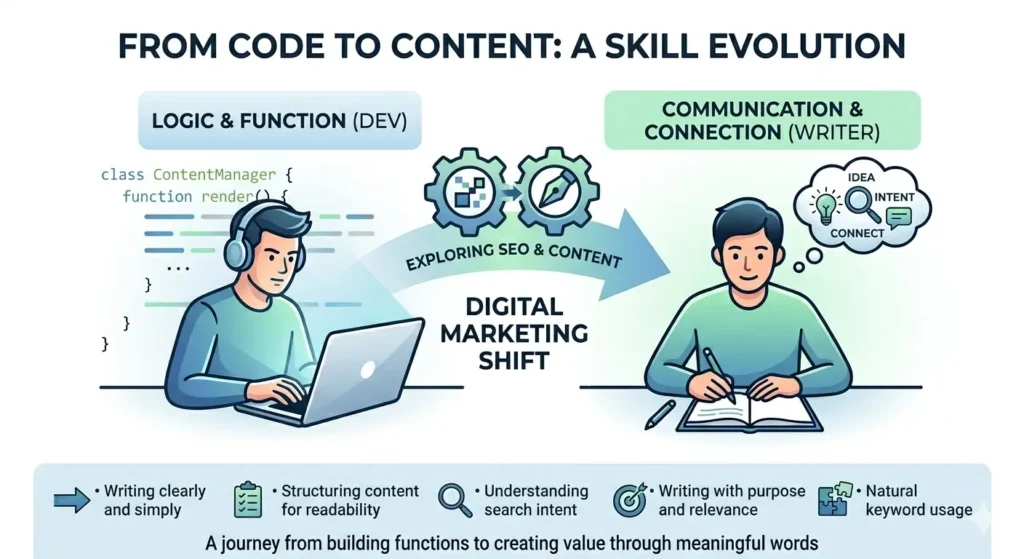
From Code to Content
For most of my career, I tackled issues as a software engineer. My work revolved around logic, structure, problem-solving, and building solutions that functioned efficiently. Every task had a clear objective, and success was measured by whether the code worked as expected.
Writing was never something I paid much attention to.
Of course, like many professionals, I wrote documentation, emails, and technical notes when required. But creative or content writing was never a skill I actively pursued. I viewed it as something completely different from the world of programming.
That perspective changed when I entered the field of digital marketing.
Discovering a Different Side of Communication
My interest in digital marketing started with curiosity.
I wanted to understand how businesses attract customers online, how websites appear on search engines, and what makes certain brands stand out in crowded markets.I discovered Search Engine Optimization (SEO), content marketing, social media marketing, and paid advertising while investigating various facets of digital marketing.
Among these areas, content marketing caught my attention.
I quickly realized that behind every successful website, ranking page, and marketing campaign was one common element: quality content.
Whether it was a blog post, landing page, product description, or website copy, content played a major role in helping businesses connect with their audience.
This realization introduced me to blog writing.
At first, I saw blog writing as a straightforward task. I assumed it was simply about sharing information and explaining a topic clearly. Since I already had experience researching and understanding technical concepts, I thought writing blogs would be relatively easy.
However, I soon discovered there was much more to it.
Learning That Writing Is About People
One of the biggest lessons I learned was that good writing is not only about information.
It’s about people.
As developers, we often focus on functionality. We build solutions that work. But when writing for an audience, functionality alone isn’t enough. Readers need to feel that the content understands their questions, challenges, and interests.
This was a completely different way of thinking.
Rather than inquiring, “What do I want to explain?”
I began asking, “What does the reader want to know?”
That simple shift changed my entire approach to writing.
I started paying attention to the problems people were searching for online. I learned to think about the questions they were asking and the solutions they were hoping to find.
The goal was no longer just to provide information. The goal was to create content that genuinely helped someone.
Understanding Search Intent
As I continued learning SEO, I came across the concept of search intent.
Initially, it seemed like another marketing term. But the more I explored it, the more I understood its importance.
Search intent refers to the reason behind a user’s search query. People search online for answers, solutions, comparisons, recommendations, or guidance.
For instance, the expectations of someone looking for “best digital marketing strategies” differ from those of someone looking for “how to start digital marketing.”
Understanding this intent became one of the most valuable skills I developed.
It taught me that successful content isn’t created solely around keywords. It is created around user needs.
This realization helped me move beyond writing for search engines and start writing for real people.
Developing Essential Writing Skills
As I wrote more blogs, I gradually developed skills that improved both my content and communication abilities.
Writing Clearly and Simply
One challenge I faced early on was simplifying information.
Coming from a technical background, I was used to complex explanations and industry terminology. However, not every reader has the same level of technical knowledge.
I learned that effective writing often means making complicated topics easy to understand.
Using simple language doesn’t reduce the value of content. Instead, it makes the content accessible to a wider audience.
This became one of the most important lessons in my writing journey.
Structuring Content for Better Readability
I also discovered that presentation matters just as much as the information itself.
Readers rarely consume content word by word from beginning to end. Most people scan articles before deciding whether to continue reading.
Because of this, content needs structure.
Using headings, subheadings, bullet points, and short paragraphs helps readers find the information they need quickly.
Good structure improves readability and creates a better overall experience.
Writing with Purpose
Another skill I developed was intentional writing.
In the beginning, I often focused on covering as much information as possible. Over time, I learned that every section of a blog should serve a purpose.
Each paragraph should help the reader move closer to understanding the topic or solving a problem.
This approach helped me create content that felt more focused, relevant, and valuable.
Using Keywords Naturally
SEO introduced me to the importance of keywords.
However, I quickly learned that effective keyword usage is not about repetition.
The best content incorporates keywords naturally while maintaining a smooth reading experience.
Readers should never feel like content was written for a search engine.
When keywords are integrated thoughtfully, they help improve visibility without affecting the quality of the writing.
The Challenge of Transitioning from Technical Thinking
Coming from software development, adapting to content creation was not always easy.
Programming follows a logical and structured process. There is usually a clear right or wrong answer.
Writing is different.
Different readers interpret content in different ways. There is creativity involved. There is emotion involved. There is a need to understand human behavior and communication.
Initially, this felt unfamiliar.
I often found myself focusing too much on technical accuracy while overlooking the reader’s experience.
Over time, I learned to balance both.
My technical background became an advantage rather than a limitation. It helped me research thoroughly, organize information effectively, and maintain clarity throughout my content.
At the same time, digital marketing taught me how to communicate that information in a way that resonates with people.
The combination of these skills helped me grow as both a writer and a marketer.
Finding Enjoyment in the Process
What surprised me most was how much I started enjoying writing.
What began as a learning exercise gradually became something I looked forward to.
I enjoyed researching new topics, understanding audience behavior, and transforming complex information into content that was easy to understand.
Every blog became an opportunity to learn something new.
Writing also encouraged me to think differently.
Instead of focusing solely on systems, features, and technical solutions, I began considering user perspectives, customer needs, and communication strategies.
This broader perspective has been valuable not only in digital marketing but also in my professional growth overall.
Where I Am Today
Today, blog writing has become an important part of my digital marketing journey.
My goal is simple: create content that is informative, practical, and easy to understand.
I believe good content should answer questions clearly, provide genuine value, and respect the reader’s time.
Whether I am writing about digital marketing, SEO, technology, or business-related topics, I focus on delivering information in a way that is useful and engaging.
I continue learning with every piece of content I create.
The digital landscape changes constantly, and staying relevant requires continuous improvement. That challenge is one of the reasons I enjoy this field.
There is always something new to learn, explore, and share.
Final Thoughts
Looking back, I never expected digital marketing to influence my career in such a meaningful way.
What started as an exploration of SEO and online marketing eventually transformed how I communicate, think, and share knowledge.
Blog writing taught me that effective communication goes beyond explaining concepts. It requires understanding people, addressing their needs, and delivering value through meaningful content.
My journey from software development to content writing has shown me that technical skills and communication skills can complement each other beautifully.
Today, I still appreciate the structure and logic that programming taught me. But I also value the ability to connect with readers through words.
Digital marketing didn’t just improve my writing skills—it expanded my perspective, strengthened my communication, and helped me discover a new way of creating value for others.
If you’re looking for a reliable digital marketing consultant in Dubai, I’m here to support your journey and help your brand grow with purpose.